

AI is already moving deeper into manufacturing. But translating those capabilities into meaningful business value remains a much harder problem.
AI can only be as useful in a manufacturing decision as the product and process context available to it. When that context remains fragmented across systems, AI may be able to answer a question without understanding the decision behind it. That's why one of the constraints on industrial AI isn't simply the AI itself. It's the information architecture underneath it.
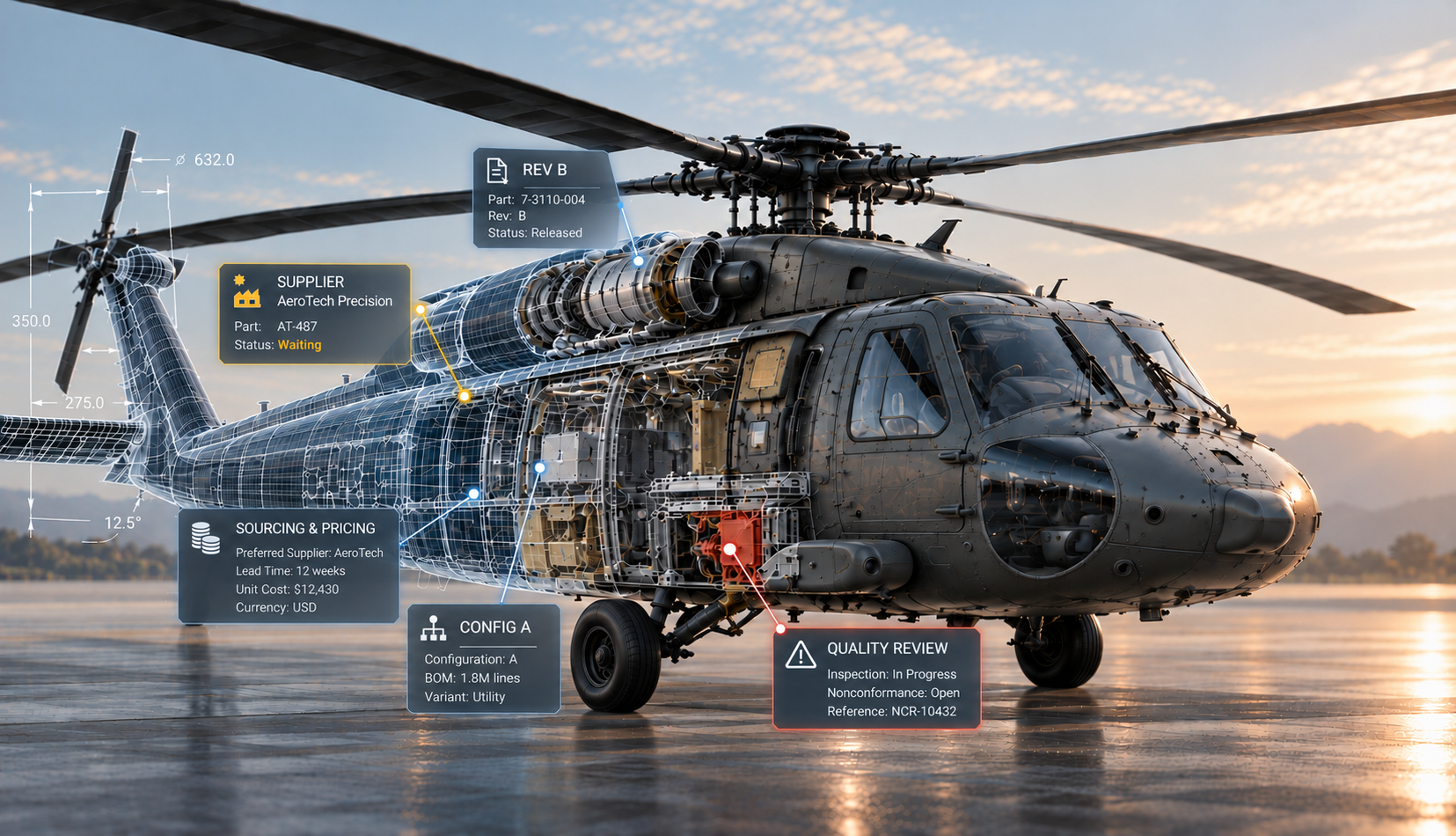
AI is increasingly being applied to decisions about products, parts, manufacturing processes, sourcing, quality, and service. But the context required to make those decisions is still distributed across specialized enterprise systems. Geometry may be authoritative in CAD. Product structure, revision, configuration, and lifecycle state may be governed in PLM. ERP adds sourcing, supplier, material, and cost information, while manufacturing, quality, and service systems contribute additional product and process context.
Those systems weren't designed poorly. They were designed to govern different parts of a very complex product definition.
The problem is that AI doesn't automatically understand the relationships among them simply because it can access their data.
For much of my career, one of the central challenges in manufacturing software has been extending product information beyond the systems and teams that create it. AI doesn't replace that challenge. It raises the stakes by requiring software to interpret information that experienced people have learned to understand in context. Experienced people often know when the information in front of them doesn't tell the whole story. They know where to verify a revision, what other system may contain the missing context, or when something simply doesn't look right. As software takes a larger role in interpreting product information and supporting decisions, we can't assume it brings that same institutional understanding with it.
Manufacturing Doesn't Just Have a Data Problem
A common way to talk about AI readiness is in terms of data: manufacturers need to connect more data, clean it, structure it, and make it available to AI.
All of that matters. But manufacturing decisions depend on more than the availability or quality of individual data points.
Product knowledge is distributed, relational, configuration-dependent, revision-dependent, and continuously changing. Different systems can legitimately be authoritative for different dimensions of the same product. A piece of information can therefore be completely accurate and still be wrong for the decision being made because it belongs to a different revision, configuration, point in time, or product context.
Consider a system helping someone determine whether an existing component could be used in a new application. Geometry might show that two parts are nearly identical, and their basic attributes may suggest that one could replace the other. But that doesn't tell the system whether the part is approved for that product configuration, whether it has been superseded, whether a quality issue restricts its use, whether its supplier is approved for the program, whether the manufacturing process imposes additional constraints, or why engineering created two similar parts in the first place.
The information needed to answer the question may exist across the enterprise.
The harder problem is preserving the context that connects it.
Giving AI access to more disconnected information doesn't necessarily produce better decisions. It can simply give the system more isolated facts to reason over.
Product Context Has to Remain Connected to Authority
The next question is how AI determines which product information it should trust.
If an AI application is going to assist with a product-dependent decision, it needs more than access to a collection of records. It needs to know what those records represent, which systems govern them, and whether they apply to the current product, configuration, and point in time.
That becomes particularly important as the product changes. Engineering releases a new revision. A BOM relationship changes. A supplier changes. Manufacturing modifies a process. Quality identifies an issue. Service accumulates new information from the field.
The enterprise doesn't suddenly have “bad data” when one of those things happens. It has an evolving product definition whose authoritative context changes with it.
AI needs to operate within that reality.
That also raises a question of traceability. If an AI-assisted workflow recommends a part, process, or action, manufacturers need to understand the product information behind that recommendation. Confidence shouldn't come only from how convincing the answer sounds. It should come from knowing what authoritative context informed it.
But providing AI with richer product context creates another requirement: that context cannot come at the expense of the governance and security already protecting it. Creating new copies, extracting sensitive product definition, or moving information into environments disconnected from existing controls can expand the security and IP problem even as it solves an access problem.
So the objective shouldn't simply be to get more product information into AI.
The objective should be to make the necessary product context available to AI-assisted workflows while preserving the authority and governance of the systems responsible for it.
That makes AI readiness an enterprise architecture problem, not simply a data problem.
AI Raises the Standard for the Digital Thread
For years, the digital-thread conversation has focused heavily on connecting systems and extending access to product information. Those challenges aren't going away. But AI raises the standard.
Making information available to AI is only part of the problem. AI-assisted decisions require product information that is current, applicable, and connected to authority.
That's why I think some of the most important work manufacturers will do around AI won't be focused on the AI model itself. It will happen in the architecture surrounding the product knowledge those decisions depend on.
As manufacturers evaluate where AI belongs across the enterprise, there is an architectural question worth asking alongside the technology questions:
What does this system actually know about our product, and how does it know that information is current, applicable, and authoritative?

COMMENTS