


Manufacturers have invested billions in PLM platforms such as Teamcenter to establish authoritative product definition across engineering organizations.
These systems govern revisions, configurations, lifecycle states, access controls, and change processes. They serve as the foundation of the digital thread.
Yet when product definition needs to reach suppliers, many organizations still rely on the same mechanism they have used for decades:
File export.
JT. STEP. 3D PDF. CAD-derived packages.
The assumption is that these files simply extend access beyond engineering.
In reality, they do something else entirely.
They break PLM governance.
Supplier collaboration provides one of the clearest examples of a broader architectural challenge: extending governed product definition beyond engineering without relying on detached file copies.
The Hidden Break in the Digital Thread
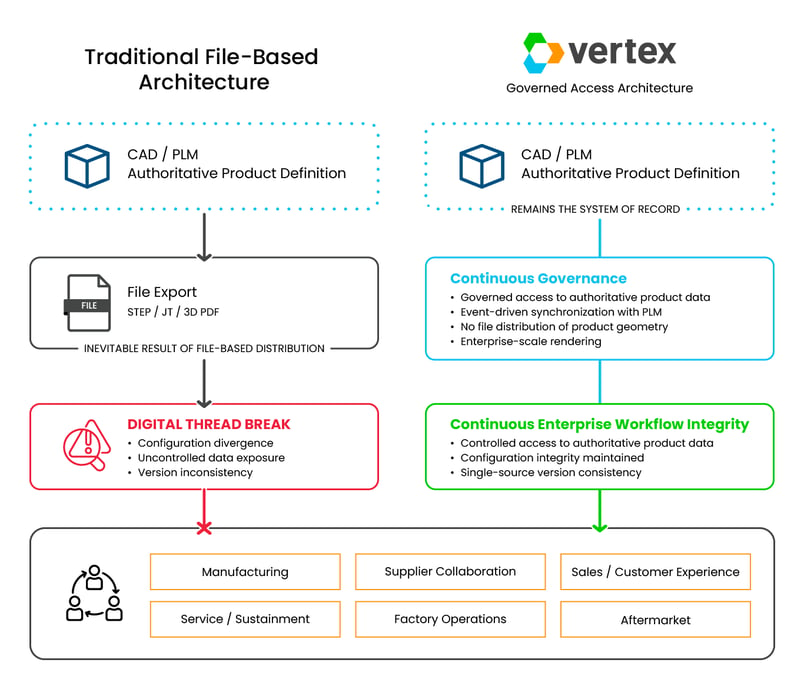
The digital thread does not typically break inside Teamcenter.
It breaks when product definition leaves the system of record.
Inside the PLM environment, product definition remains connected to configuration context, revision history, lifecycle state, access controls, and engineering change processes.
Once that information is exported into a file, the supplier receives useful geometry, but the governance context that made it authoritative is no longer intact.
The exported file becomes a detached working copy.
From that point forward:
- Configuration context weakens
- Versions begin to diverge
- Engineering changes require re-export cycles
- Access revocation becomes difficult
- Intellectual property exposure expands beyond controlled boundaries
The issue is not file-transfer efficiency.
The issue is governance continuity.
The industry has traditionally treated access and distribution as the same architectural problem. They are not.
Why Supplier Collaboration Still Depends on Files
Supplier collaboration architectures were designed for an era when the primary challenge was extending access beyond engineering.
Manufacturers needed a practical way to share product definition with organizations that did not have direct access to PLM systems.
File distribution was an easy fix.
Today, however, the constraint has changed.
Manufacturers are operating increasingly complex supplier ecosystems that require continuous alignment across engineering, sourcing, manufacturing, and external partners.
Suppliers need access to current product definition.
Engineering needs confidence that suppliers are working from current intent.
Program leaders need visibility into progress, risk, and resolution.
Yet most collaboration processes still depend on repeatedly exporting, packaging, transferring, reviewing, and reconciling derivative files.
The result is a workflow built around managing copies rather than maintaining continuity with the authoritative source.
Supplier collaboration illustrates this challenge particularly well because every engineering change introduces another synchronization event between the authoritative product definition and detached working copies.
The Problem Isn't Better File Sharing
Many organizations attempt to improve supplier collaboration by making file distribution more efficient through faster transfers, better portals, and increasingly automated packaging workflows. While these efforts may reduce some friction, they do not address the underlying architectural issue.
The collaboration model still depends on detached copies of product definition. As long as exported files become the working truth, governance remains disconnected from the collaboration process.
The question is no longer, "How to distribute product definition more efficiently?"
The more important question is, "How to preserve governance wherever product definition is consumed?"
Three Questions That Reveal the Architectural Constraint
Before evaluating alternative approaches to supplier collaboration, manufacturing leaders should ask three questions:
1. Where do our supplier workflows still depend on exported JT, STEP, 3D PDF, or CAD-derived packages from Teamcenter?
2. How do we know suppliers are working from current product intent after export?
3. What happens to configuration control, IP containment, and access revocation once files leave the governed environment?
If those questions are difficult to answer, the challenge is not file-transfer efficiency.
It is governance continuity.
That distinction requires rethinking how product definition is accessed, not simply how files are distributed.
A Different Model: Governed Access Instead of File Distribution
If file export is where governance breaks, the solution is not better file transfer—it is governed access. In this model, Teamcenter remains the authoritative system for product definition, configuration management, and engineering change governance. Rather than exporting files to suppliers, manufacturers extend access through a governance-preserving 3D access layer.
Suppliers interact with current product definition through browser-based experiences while Teamcenter remains the source of truth.
Product definition is streamed as context-aware pixels within controlled environments, enabling interaction without distributing geometry files.
This fundamentally shifts the control point: instead of attempting to govern copies after they have been distributed, manufacturers govern access before product definition is exposed.
Extending Teamcenter Governance Through Supplier Collaboration
This architectural approach enables manufacturers to extend Teamcenter governance across supplier collaboration without making exported files the collaboration substrate.
Rather than distributing detached copies of product definition, organizations provide governed access while Teamcenter remains the authoritative system for product definition, configuration management, and engineering change.
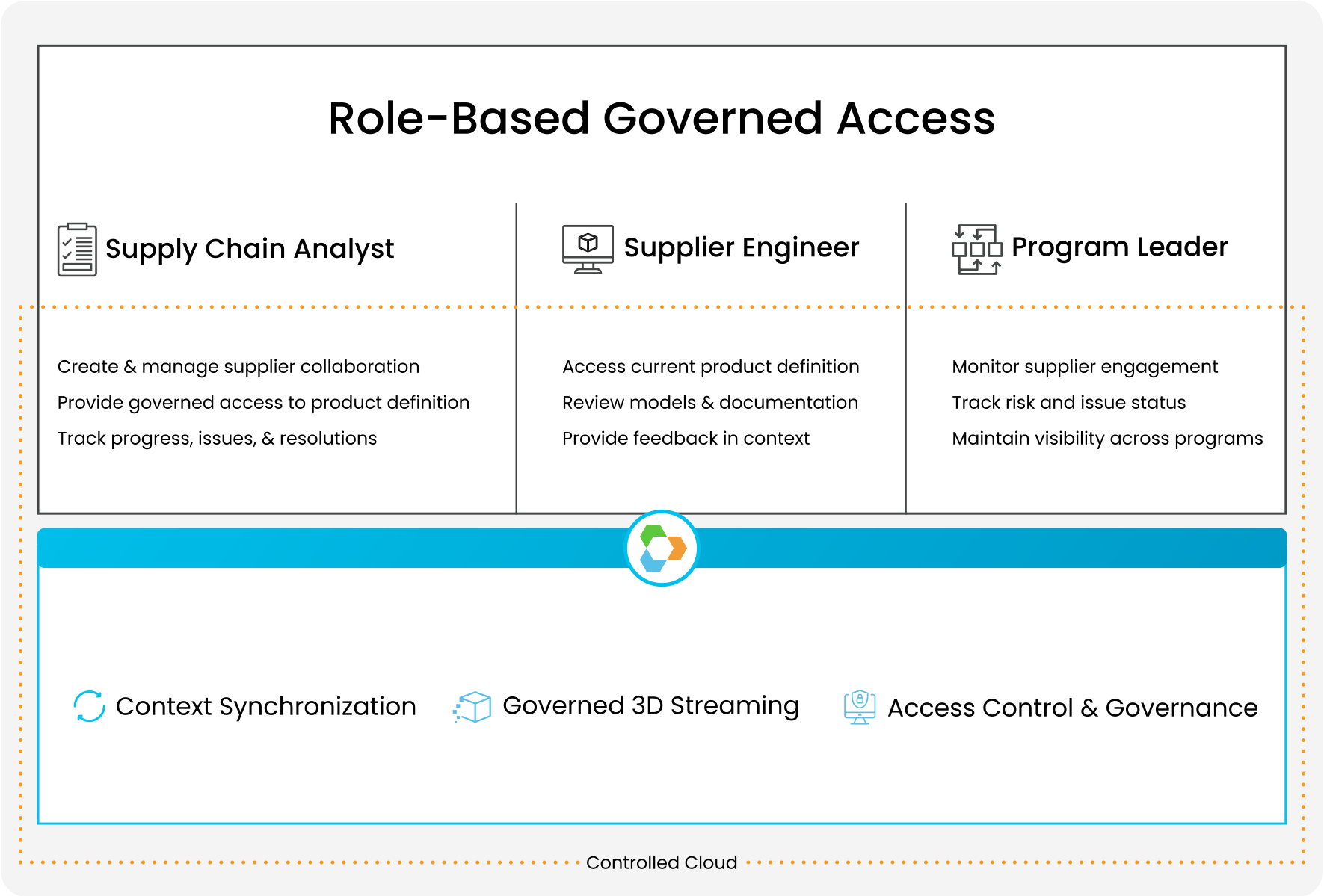
Within this architecture, each participant interacts with the same authoritative product definition according to their role:
Supply Chain Analysts
- Govern supplier collaboration from the authoritative product definition
- Extend controlled access without exporting files
- Monitor supplier engagement, issues, and program execution
Supplier Engineers
- Access current product definition through governed browser-based experiences
- Review engineering content and provide contextual feedback
- Work without receiving or maintaining local geometry files
Program Leaders
- Monitor collaboration progress across supplier ecosystems
- Track risks, issues, and resolution status
- Maintain alignment around current product definition
Rather than coordinating disconnected file exchanges, every participant remains connected to the same governed product definition while Teamcenter continues to serve as the system of record.
Continuous Alignment Instead of File Loops
Traditional supplier workflows create a recurring cycle:
Export.
Package.
Transfer.
Review.
Respond.
Re-export.
Repeat.
Every engineering change introduces another synchronization event.
Every supplier interaction introduces another opportunity for divergence.
Governed access changes the operating model.
Suppliers work directly from current product definition.
Feedback remains attached to product context.
Engineering changes become immediately available without re-export cycles.
Engineering, sourcing, and suppliers remain continuously aligned.
The workflow becomes governed by architecture rather than dependent on process discipline.
Operational Impact at Scale
Preserving governance is the architectural outcome.
Eliminating export and reconciliation cycles is the operational outcome.
When organizations eliminate export, transfer, and reconciliation loops, collaboration accelerates dramatically.
Production deployments have demonstrated:
- Up to 66× faster supplier collaboration cycles
- 75% of design shares completed in under 10 minutes
- Browser-based access instead of file-package preparation
- Governed collaboration across supplier networks exceeding 22,000 suppliers
The important point is not speed alone.
It is speed while preserving governance.
Proven at Enterprise Scale
This is not a conceptual architecture or an isolated pilot. Governed access is already operating across global manufacturing environments, supporting:
- 350,000+ users
- 500,000+ daily sessions
- 60,000+ PLM changes processed daily
- 12 million+ frames rendered per month
The architecture was designed for enterprise manufacturing scale, where maintaining governance across large supplier ecosystems is no longer optional.
The Future of Supplier Collaboration
The industry has spent years improving file-based supplier collaboration.
The bigger opportunity is to remove file dependency altogether.
Teamcenter already governs product definition.
The challenge is extending that governance beyond engineering.
That requires a new architectural layer—one that preserves governance while enabling suppliers to interact with current product definition.
The future of supplier collaboration is not better file sharing.
It is governed access.
Supplier collaboration is one example of a broader architectural transition taking place across manufacturing. As product definition extends beyond engineering to additional business functions and external partners, the challenge is increasingly one of governance rather than distribution.
And the organizations that make that shift will be able to extend the digital thread across supplier ecosystems without breaking it at file export.

COMMENTS